Most LLM inference advice assumes you have an H100 cluster. I usually don’t. My systems run where the budget is — constrained servers, edge boxes, cost-sensitive B2B deployments. Here is the shortlist of techniques that actually move the needle, in the order I’d reach for them.
1. Quantization first, always
Dropping from FP16 to INT8 or INT4 is the single biggest lever: smaller weights mean less memory bandwidth, and LLM decoding is almost always memory-bandwidth bound, not compute bound. In practice:
- INT8 (smooth-quant style / LLM.int8()) — near-lossless on most models, halves memory.
- INT4 (AWQ, GPTQ) — roughly 3–4× smaller, small quality cost. AWQ tends to preserve accuracy better at 4-bit because it protects salient weights.
- GGUF (Q4_K_M and friends) — the practical choice for CPU inference with llama.cpp.
Rule of thumb: quantize before you optimize anything else. A 4-bit 70B model on two consumer GPUs will out-serve a 16-bit 13B on one, on both throughput and quality.
2. KV-cache is your memory budget
Every concurrent request holds a KV-cache proportional to sequence length. The math is unforgiving:
Two (keys and values) times layers times hidden size times tokens times bytes per element. A 70B-class model at FP16 with 8k context holds roughly a gigabyte of cache per request — which is why long contexts plus high concurrency is how OOMs happen. Manage it explicitly:
- Cap
max_seq_lenper deployment, not per model default. - Evict idle sessions aggressively — a chatbot holding 8k tokens of cache for an idle user is throughput theft.
- If your framework supports paged attention (vLLM, TensorRT-LLM), use it. It kills cache fragmentation and typically buys 2–4× concurrency at the same memory.
3. Continuous batching
Naive servers process one request at a time or wait to fill a batch. Continuous batching (vLLM’s signature move) inserts new requests into the running batch at every decoding step. Under mixed traffic this alone can multiply throughput several-fold with zero quality impact. If you’re still on a naive Hugging Face generate() loop in production, this is your upgrade.
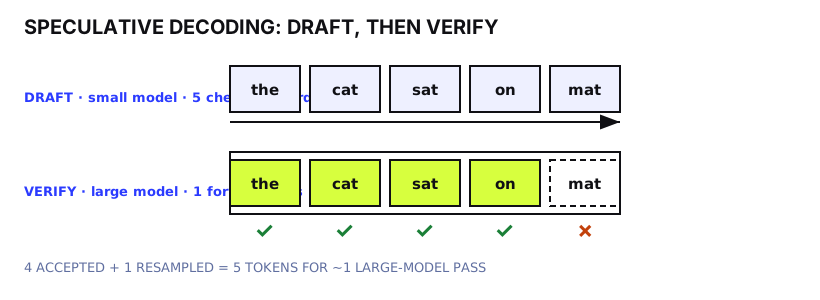
4. Speculative decoding — free latency
Draft with a small model, verify with the large one. When the draft agrees (which it does surprisingly often on structured output — JSON, code, form-filling), you get multiple tokens per large-model forward pass. Gains of 1.5–2.5× on latency are realistic for exactly the boring enterprise workloads (extraction, classification, templated generation) that dominate real deployments.
5. Stop calling the big model for everything
In agentic systems this dwarfs everything above. Route: regex and classifiers for the trivial, a small model for the routine, the frontier model only for genuine reasoning. Cache aggressively — system prompts and few-shot prefixes should be prefix-cached, and repeated queries should hit a semantic cache before they hit the model. I’ve seen routing plus caching cut inference spend by an order of magnitude on CRM-style workloads.
flowchart LR
    Q[Incoming query] --> C{Cache hit?}
    C -->|Yes| R[Return answer]
    C -->|No| S{Routine or reasoning?}
    S -->|Routine| SM[Small model]
    S -->|Reasoning| BM[Frontier model]
    SM --> W[Write back to cache]
    BM --> W
    W --> R
The checklist
- Quantize (INT8 minimum, INT4 where quality allows)
- Serve with continuous batching (vLLM / TensorRT-LLM / llama.cpp server)
- Budget the KV-cache; enable paged attention
- Add speculative decoding for latency-sensitive paths
- Route and cache so the big model only sees hard problems
Do those five and you’ve captured the vast majority of available gains — no cluster required.
← All posts